Lead Management for Marketing Agencies: 2026 Sales Guide
Discover how modern marketing agencies manage leads, track multi-channel inquiries, and build high-converting follow-up systems without complex CRM overhead.

Consider a typical Tuesday at a boutique digital marketing agency.
At 8:15 AM, an inbound message arrives in the agency director's LinkedIn inbox asking about SEO retainers for a regional healthcare group. At 10:30 AM, a website inquiry form pings through from an e-commerce founder seeking paid social ad management. By lunchtime, a former client leaves a direct message on Instagram introducing a colleague, while an email referral lands from a trusted design partner.
Because the team is neck-deep in client ad creatives, reporting dashboards, and weekly performance reviews, only the LinkedIn inquiry receives an immediate reply. The Instagram DM sits unread behind a stack of social notification badges. The website form is flagged "to review tomorrow," and the email introduction is marked unread in a swollen inbox.
Three weeks later, the agency wraps up an intensive campaign delivery and discovers a familiar pit in the stomach: the sales pipeline is dry. When the founder finally searches through their sent messages and direct message threads, they realize that two of those warm inquiries never received a response, while another received a single introductory sentence and was subsequently forgotten.
For boutique marketing agencies, freelance marketers, and independent consulting firms, client acquisition struggles are rarely caused by a shortage of market interest. More often, they stem from a silent, systemic failure: the absence of a reliable, lightweight system for lead management for marketing agencies.
When you run a service business without a dedicated enterprise sales department, business development naturally competes with client delivery. Without a clear follow-through structure, promising conversations slip through administrative cracks, leaving thousands of dollars in prospective retainer revenue on the table.
In this comprehensive guide, we examine why marketing agencies routinely lose interested prospects after initial contact, what a practical agency lead management framework actually requires, and how to maintain consistent business development momentum in just 15 minutes each day.
Why Marketing Agencies Lose Potential Clients After the First Conversation
Every marketing agency recognizes the difficulty of generating qualified business inquiries. Yet across the industry, an alarming volume of prospective client conversations quietly stall after the very first interaction.
This breakdown rarely happens because a prospect explicitly rejects the agency. Rather, it occurs because agency business development suffers from seven operational vulnerabilities:
- Scattered Communication Channels: Inquiries rarely arrive through a single gateway. Potential clients reach out via LinkedIn InMail, Instagram direct messages, website contact forms, WhatsApp chats, email introductions, and post-conference exchanges. When inquiries are distributed across five or six disconnected inboxes, no single team member has an integrated view of who is waiting for a reply.
- Delayed Initial Responses: Agency founders and account directors spend their workdays immersed in campaign execution, client workshops, and team coordination. A prospective client who reaches out with high buying intent on Tuesday morning often waits forty-eight to seventy-two hours for a thoughtful reply. In high-ticket services, conversational momentum deteriorates rapidly with each passing day.
- Forgotten Follow-Ups: In digital communication channels, inboxes are organized chronologically, not strategically. As new messages, newsletters, and internal notifications arrive, older conversations are pushed downward. If a prospect replies with "Sounds interesting, let me check with my partner," that thread vanishes beneath new email noise within forty-eight hours unless a specific follow-up date is recorded.
- Missing Conversation Context: When following up two weeks after an initial chat, agency owners frequently forget the prospect's original stated friction points, target deliverables, or budgetary parameters. Sending a vague message such as "Just checking in to see if you had any thoughts" signals a lack of attentiveness and undermines the agency's premium positioning.
- Multiple Competing Team Responsibilities: In small and mid-sized agencies, the individuals responsible for closing sales are usually the same individuals managing client fulfillment, hiring contractors, and reviewing monthly performance. When client deliverables become urgent, proactive business development is invariably the first activity postponed.
- No Clear Next Action Defined: Many agency conversations conclude ambiguously with phrases like "Let me know what you think" or "Feel free to reach out whenever you are ready." Without a mutually agreed next milestone—such as a 20-minute diagnostic session or a scope review call—the prospect carries the cognitive burden of re-initiating contact.
- Poor Visibility Into Active Opportunities: Without a consolidated pipeline, agency leadership cannot answer basic commercial questions: How many qualified opportunities are active right now? What is their aggregate deal value? Which three prospects require a follow-up touchpoint today?
To explore how independent operators maintain conversational momentum across social platforms without putting their accounts at risk of algorithmic restrictions, review our guide to anti-ban Instagram and LinkedIn DM follow-up strategies.
The Hidden Cost of Poor Lead Management
When prospective client inquiries are managed haphazardly, the commercial damage extends far beyond the emotional frustration of a lost deal. The operational costs quietly compound across every area of an agency's business:
- Wasted Time Searching Across Inboxes: Agency owners report spending dozens of minutes each week digging through LinkedIn message histories, Instagram threads, and personal inboxes trying to locate a prospect's name, company website, or previous discussion notes.
- Lost High-Ticket Retainers: B2B buyers rarely wait indefinitely for an agency to follow up. When an agency goes silent, the prospect assumes the firm is either disengaged, unorganized, or over capacity, prompting them to initiate discussions with competing agencies.
- Repeated and Redundant Manual Work: When lead tracking is disorganized, different team members often duplicate outreach or ask prospects for information they already provided during an earlier exchange, creating a disjointed client experience.
- Inconsistent Client Experience: Premium client pricing requires premium professional positioning. If an agency's initial sales interaction feels fragmented, prospective clients naturally question whether campaign reporting and project deliverables will be equally disorganized.
- Difficulty Forecasting Revenue and Hiring: When an agency cannot accurately track prospective deals through verifiable stages, predicting quarterly cash flow becomes guesswork. This makes strategic hiring decisions—such as bringing on a full-time media buyer or account strategist—needlessly risky.
- Lost Momentum After an Initial Inquiry: Warm inbound inquiries possess an expiration date. An inquiry that sits dormant for three weeks requires five times more consultative effort to revive than a lead nurtured within forty-eight hours.
To understand the financial implications in concrete terms, consider a hypothetical boutique agency charging an average retainer fee of $3,500 per month. If that agency receives eight genuine inquiries per month but loses just two of them to administrative oversight, delayed replies, or forgotten follow-ups, that represents $7,000 in monthly recurring contract value left on the table. Over a twelve-month horizon, that simple administrative leakage amounts to $84,000 in lost top-line revenue—arising purely from conversations that had already been initiated.
What an Effective Lead Management System Should Include
To eliminate lead leakage without burying your team in unnecessary administrative complexity, a modern agency lead management framework must incorporate seven essential pillars:
- Centralized Prospect Records: A unified repository holding the prospect's full name, business or brand name, primary contact channel (e.g., LinkedIn, email, Instagram), and current operational status.
- Lead Source Tracking: Clear identification of where each inquiry originated (e.g., website contact form, organic LinkedIn post, inbound referral, partner network, or live speaking engagement) to understand which marketing activities produce actual business opportunities.
- Conversational Context and Core Requirements: A dedicated space preserving the prospect's exact language: their primary business objective, current obstacles, existing ad spend or team setup, and specific deliverables discussed.
- Follow-Up Scheduling with Exact Calendar Dates: Every active lead must possess an explicit follow-up date. If an opportunity does not have a designated next touchpoint on the calendar, it is effectively forgotten.
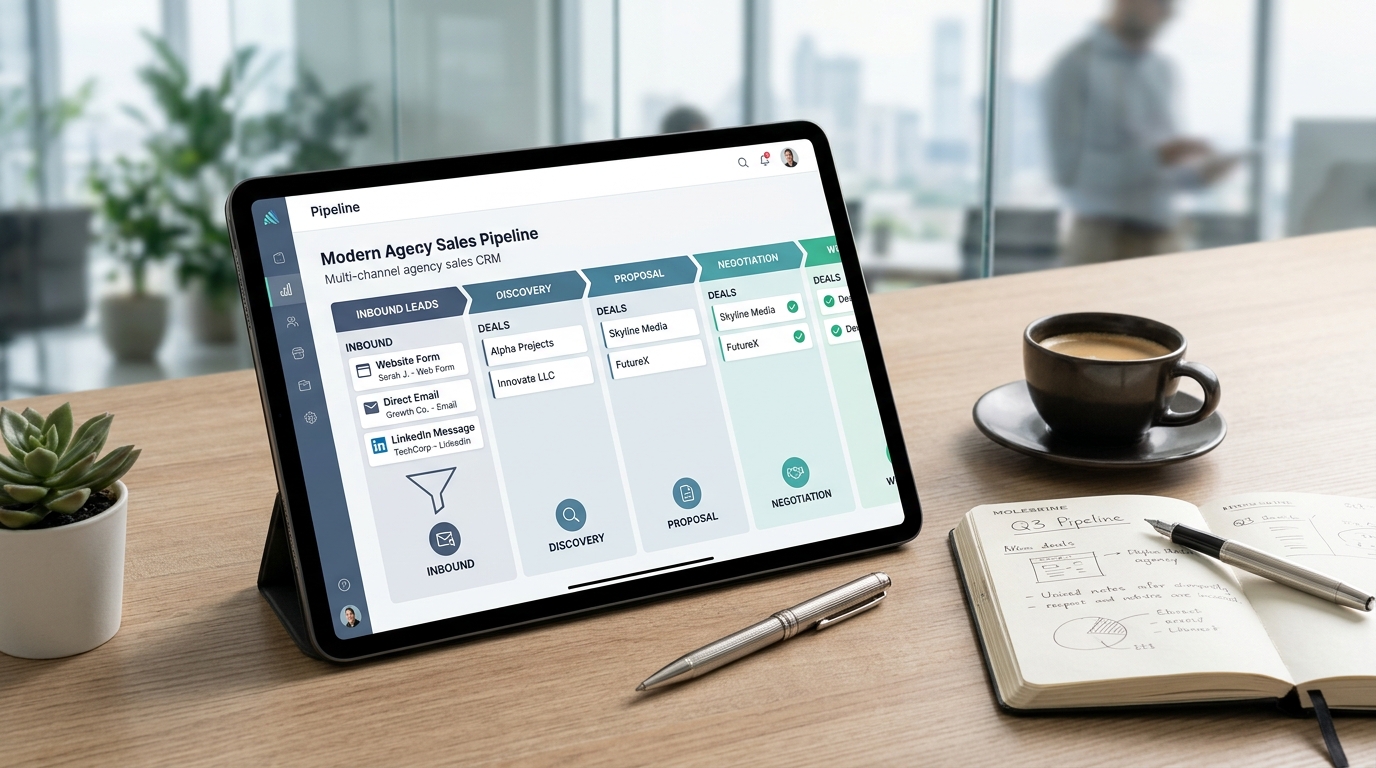
- A Clear, Milestone-Driven Sales Pipeline: Visual progression stages that reflect objective buyer commitment rather than subjective seller enthusiasm.
- Next-Action Visibility (The Morning Action Queue): A clutter-free daily view that surfaces only the prospects whose scheduled touchpoint is due today, answering the morning question: "Who do I need to reach out to right now?"
- Discovery Call and Conversion Tracking: Systematic logging of completed discovery sessions, delivered proposals, won retainers, and archived opportunities for future seasonal re-engagement.
Simplicity and consistent daily execution matter infinitely more than software complexity. An agency does not need a massive enterprise database with four hundred custom fields; it needs a frictionless operating system that team members will actually use every single morning.
For agencies that collaborate with virtual assistants or fractional coordinators to handle research and fulfillment handoffs, establishing standardized documentation is equally vital. Explore our creative brief blueprint for consultants and VAs to standardize project handoffs once deals are closed.
How to Build a Practical Lead Follow-Up Process for a Marketing Agency
A reliable lead management system is only as effective as the daily workflow that supports it. Below is a battle-tested, seven-step agency follow-up workflow designed to move prospects from first contact to signed retainer:
```
[Inbound Inquiry] ──> [Context Capture] ──> [Stage Assignment] ──> [Schedule Follow-Up] ──> [Draft Personalized Message] ──> [Manual Dispatch via Native App] ──> [Update Pipeline Stage]
```
Step 1: Capture Every Relevant Inquiry
The moment an inquiry arrives—whether via a LinkedIn direct message, an Instagram DM, a website submission, or an introduction after a virtual event—log the lead into your tracking workspace within four hours. Do not rely on mental notes or leave the message unread as a reminder.
Step 2: Record the Prospect's Needs and Context
Copy the core elements of the prospect's inquiry into their record:
- What specific service are they seeking (e.g., paid acquisition, content strategy, brand repositioning)?
- What stated obstacle did they articulate (e.g., rising customer acquisition costs, lack of internal creative bandwidth)?
- What is their target timeline or budget parameter?
Step 3: Identify the Current Stage of the Opportunity
Assign the lead to an initial pipeline stage. For most agencies, five clear milestones provide optimal clarity:
- Inquiry Received: Initial contact made; qualification required.
- Discovery Booked: Diagnostic strategy call confirmed on the calendar.
- Scoping / Proposal Review: Strategy session completed; proposal or scope being prepared.
- Decision in Progress: Proposal delivered; prospective client reviewing with internal leadership.
- Won Retainer / Nurture Archive: Agreement signed, or archived with a scheduled check-in for next quarter.
Step 4: Decide the Next Action and Follow-Up Date
Never leave a lead record without an assigned date. If you send an introductory note proposing a discovery call on Tuesday, set a follow-up reminder for Friday morning. If a prospect requests two weeks to review a proposal with their CFO, immediately set the follow-up milestone for fourteen days out.
Step 5: Prepare a Relevant, Personalized Follow-Up
When the scheduled follow-up date arrives, craft a concise message that references the specific challenges discussed in earlier conversations. Avoid generic "checking in" phrases; instead, offer an advisory insight, share a relevant client case observation, or provide a direct question that simplifies their decision.
Step 6: Send the Message Through the Original Communication Channel
Send the vetted message directly through the channel where the prospect initiated contact (e.g., LinkedIn, Instagram, or email). Maintaining channel continuity ensures the recipient experiences the exchange as a natural, human conversation rather than automated marketing outreach.
Step 7: Update the Prospect's Status and Track the Outcome
Once the message is dispatched, mark the task complete and assign the next milestone date. If the prospect confirms a call, advance them to "Discovery Booked." If they decline or go silent after multiple attempts, move them to the nurture archive for seasonal follow-up.
---
Realistic Walkthrough: Managing an Agency Opportunity From Inquiry to Retainer
To see this seven-step process in action, consider how a boutique performance marketing agency manages a prospective client:
- Day 1 (Initial Inquiry): Jordan, founder of an outdoor apparel brand, sends a LinkedIn direct message: "Saw your post on reducing blended CAC for DTC brands. We're spending $25k/mo on Meta ads but our ROAS dropped significantly in Q2. Do you take on new e-commerce clients?"
- Action Taken: The agency founder inputs Jordan into their lead management workspace, tags the source as "LinkedIn", records the primary need ("DTC Meta ROAS stabilization; $25k/mo ad spend"), and replies on LinkedIn with a brief diagnostic question and a booking link for a 20-minute audit call. The follow-up date is set for Day 4.
- Day 4 (Discovery Scheduled): Jordan books a discovery session for Day 6. The agency updates the stage to "Discovery Booked" and prepares diagnostic audit questions based on the brand's public store and ad library.
- Day 6 (Discovery Call & Scope): The agency conducts a focused 25-minute strategy call, identifying creative fatigue as Jordan's core bottleneck. They agree to deliver a scoped growth proposal by Day 8. The stage is updated to "Proposal Review."
- Day 8 (Proposal Delivery): The agency delivers a tailored 3-month growth retainer proposal ($4,500/mo) via email and sets a follow-up reminder for Day 12.
- Day 12 (Consultative Follow-Up): The morning action queue prompts a touchpoint. The founder sends a personalized LinkedIn message: "Hey Jordan, hope the week is off to a great start. When you review section 3 of the proposal regarding creative batching, let me know if you'd like me to walk through how we handle the UGC creator sourcing. Happy to clarify any questions before your team sync."
- Day 14 (Retainer Won): Jordan replies: "Thanks for following up! The creative batching model was exactly what we needed. Sending the signed agreement over today." The stage is updated to "Won Retainer," and onboarding deliverables begin.
When timing stalls occur during the proposal phase, having calibrated conversational frameworks prevents awkward pressure. For exact scripts on navigating client budget delays calmly, explore our guide on how to recover stalled discovery calls with consultative tone calibration and our deep-dive into sales objection handling psychology for coaches and consultants.
Spreadsheet vs Traditional CRM vs Lightweight Lead Management Software
Agency owners frequently struggle to choose the right technology for lead tracking. The table below outlines how common approaches compare across critical operational dimensions:
| Operational Dimension | Spreadsheets (Google Sheets / Excel) | Traditional Enterprise CRM (Salesforce / HubSpot) | Lightweight Follow-Through Cockpit (Kasbna) |
|---|---|---|---|
| Initial Setup Time | 1 to 2 hours | 20 to 60 hours | Under 2 minutes |
| Daily Administrative Burden | Moderate (manual row formatting) | High (mandatory field validation) | Low (under 15 minutes per day) |
| Context & Notes Preservation | Poor (static cells truncate text) | Moderate (buried across multiple tabs) | High (AI extracts core decision points) |
| Follow-Up Cue Generation | None (relies on manual memory) | Complex automated workflows | Prioritized daily action queue |
| Multi-Channel Compatibility | Manual copy-pasting | Requires costly third-party API connectors | Seamless text & screenshot OCR capture |
| Account Safety & Compliance | Manual | Often relies on scraper bots | 100% human-approved dispatch |
| Team Adoption Rate | High initially, then abandoned | Often resisted due to complexity | Consistently high due to minimal friction |
When a Spreadsheet Is Sufficient
A simple spreadsheet is an acceptable starting point for a solo freelance marketer managing fewer than three to five active inquiries per month. Spreadsheets are free, flexible, and require no software subscription. However, as inquiry volume grows, spreadsheets inevitably break down: they cannot alert you when a follow-up is due, they truncate conversational context, and they require tedious manual data entry that busy founders quickly abandon.
When a Traditional CRM Makes Sense
Heavyweight enterprise CRMs are well-suited for agencies with twelve or more full-time business development representatives, complex multi-tier sales territories, and formal enterprise security mandates. These systems provide extensive audit trails and enterprise reporting. However, for boutique agencies and independent consultants, traditional CRMs often introduce severe friction: team members spend more time filling out required form fields and debugging API connectors than actually communicating with prospects.
Why a Lightweight Follow-Through System Excels
A lightweight, follow-through-focused workspace provides the ideal middle ground for boutique marketing agencies. It offers the automated reminders and pipeline clarity of a CRM, without the administrative bloat, excessive configuration, or high monthly overhead. By focusing ruthlessly on what matters—who contacted you, what they need, and when to follow up—it ensures consistent daily execution.
To understand how high-performing advisory firms structure their sales operations to scale smoothly past five-figure monthly targets, read our detailed analysis on coaching and consulting retainer pipeline management.
How AI Can Improve Lead Management Without Replacing Human Relationships
In recent years, artificial intelligence has often been misapplied in sales—manifesting as aggressive spam bots, automated LinkedIn message blasters, and impersonal email scrapers that destroy account reputation and alienate high-value prospects.
However, when deployed thoughtfully as an executive copilot, AI dramatically enhances agency lead management without sacrificing personal authenticity:
- Extracting Key Details from Pasted Inquiries: Instead of manually typing prospect names, websites, project requirements, and budget parameters into twelve separate fields, an agency owner can simply paste a raw conversation thread or upload a mobile DM screenshot. Modern AI extracts the prospect's identity, core need, and hesitation in seconds.
- Summarizing Client Requirements: AI rapidly synthesizes lengthy client messages into concise diagnostic summaries, ensuring that team members can digest weeks of back-and-forth communication in thirty seconds before an important discovery call.
- Identifying Explicit Hesitations: Natural language models can pinpoint subtle timeline or budget hesitations embedded in a prospect's casual phrasing (e.g., "We're waiting on our Q3 board sign-off"), alerting the agency to calibrate its follow-up accordingly.
- Drafting Contextually Relevant Messages: AI can prepare tailored follow-up drafts that reference previous conversational details while matching the agency's natural consultative tone.
- Suggesting Logical Next Steps: Based on the current stage of the opportunity, AI can recommend the most appropriate commercial action—whether that means offering a strategic audit, providing a calendar link, or suggesting a polite professional release.
Crucially, AI should assist human decision-making, not replace it. The final message should always be reviewed, adjusted, and dispatched manually by a human professional. For a comprehensive breakdown of high-converting consultative messaging structures, explore our proven high-ticket sales follow-up framework.
How Kasbna Helps Marketing Agencies Keep Opportunities Moving
Kasbna was built specifically to solve the daily follow-through challenge for boutique marketing agencies, independent consultants, and advisory firms who reject bloated enterprise software.
Rather than trying to be an all-in-one ERP or a complex database manager, Kasbna functions as a lean, focused morning follow-up cockpit:
- Centralized Prospect & Context Management: Store all active prospects, communication channels, stated business goals, and historical notes in one unified, responsive workspace.
- Instant Multi-Channel Lead Ingestion: Ingest prospective client inquiries in seconds—either by typing details manually, pasting raw conversation text from email or chat, or uploading a mobile screenshot via intelligent OCR.
- Context-Aware AI Extraction & Draft Generation: Kasbna's privacy-focused AI extracts prospect requirements and prepares tailored, stage-calibrated follow-up messages with selectable tones (Consultative, Direct, Soft, or Urgency).
- Milestone-Driven Sales Pipeline: Track opportunities across five clean stages—Inquiry, Discovery Booked, Scoping, Decision, and Retainer Won—with zero unnecessary field validation.
- The Morning Action Queue: Kasbna's signature dashboard surfaces only the leads requiring attention today, categorizing them into Overdue, Due Today, and Scheduled Next.
- 1-Click Copy and Human-Approved Dispatch: Agency founders can review a drafted reply, tweak it to perfection, copy it with a single click, and send it directly through the prospect's native channel (LinkedIn, Instagram, WhatsApp, or Email). No account-jeopardizing bots, no automated browser scraping, and zero risk to your social profiles.
- Discovery Call & Calendar Synchronization: Integrate discovery call bookings seamlessly, export follow-up reminders directly to Google Calendar or Apple Calendar via standardized .ics sync, and monitor weekly conversion velocity.
Kasbna does not pretend to replace complex enterprise ERPs for global corporations. It is designed specifically for independent practitioners and boutique marketing agencies who want an intuitive, anti-bloat workspace that turns unbooked conversations into signed retainer clients.
A Simple Daily Lead Management Routine for Agency Owners
Consistency beats intensity. Spending fifteen minutes on lead follow-through every morning will yield vastly superior business development results compared to conducting sporadic, four-hour outreach marathons once a month.
Here is an example of an actionable, 15-minute morning routine:
- Minutes 1–3: Review the Morning Action Queue
Open your follow-up cockpit and inspect today's scheduled follow-ups. Identify which prospects have reached their milestone check-in date.
- Minutes 4–6: Triage New Inquiries
Quickly ingest any new inquiries that arrived over the past twenty-four hours across LinkedIn, website forms, or email. Record their primary need and assign their first follow-up date.
- Minutes 7–11: Review Context & Dispatch Follow-Ups
Review the conversational notes for today's active leads. Review the prepared follow-up draft, make any personal wording adjustments, copy the text, and send it directly via the prospect's original channel.
- Minutes 12–14: Advance Pipeline Stages & Assign Next Dates
Update each prospect's stage based on their response. If a discovery session was confirmed, assign the prep date; if a follow-up was dispatched, set the next check-in milestone for three to five days out.
- Minute 15: Review Discovery Call Preparations
Examine any discovery calls scheduled for the upcoming forty-eight hours, ensuring client audit notes and diagnostic questions are ready.
By embedding this fifteen-minute discipline into your daily calendar, business development becomes an automated habit rather than an overwhelming chore.
Final Thoughts — Better Lead Management Starts With Better Follow-Through
In the competitive landscape of digital marketing services, agency growth is rarely constrained by your ability to deliver exceptional client results. Nor is it constrained by a lack of potential interest in your expertise.
More often, the boundary between an agency struggling with unpredictable revenue cycles and an agency enjoying predictable retainer growth is the discipline of daily follow-through.
When you capture every inquiry immediately, preserve the prospect's original words, assign clear milestone dates, and reach out consistently with consultative value, you transform scattered inboxes into a reliable engine for sustainable business growth.
Your agency doesn't necessarily need more software or a complicated sales process. It needs a reliable way to keep every promising conversation moving forward. Explore how Kasbna can help you organize prospects, manage follow-ups, and stay on top of your next opportunities.
Make Every Conversation Count.


Authoritative Industry Citations
Related Kasbna Architectural Systems
- High-Ticket Sales Follow-Up Framework (5-Minute DM System) →
- Anti-Ban Instagram and LinkedIn DM Guide (Zero-Scraper Safety) →
- Recover Stalled Discovery Calls with Consultative Tone Calibration →
- Creative Brief Blueprint for Consultants and Team VAs →
- Coaching Retainer Pipeline Management ($50k MRR Scaling Model) →
- Sales Objection Handling Psychology for Independent Coaches →
Experience the 5-Minute Morning Cockpit
Stop losing qualified inquiries to inbox chaos. Kasbna turns stalled conversations into confirmed discovery calls with zero platform scrapers and verified account safety.